
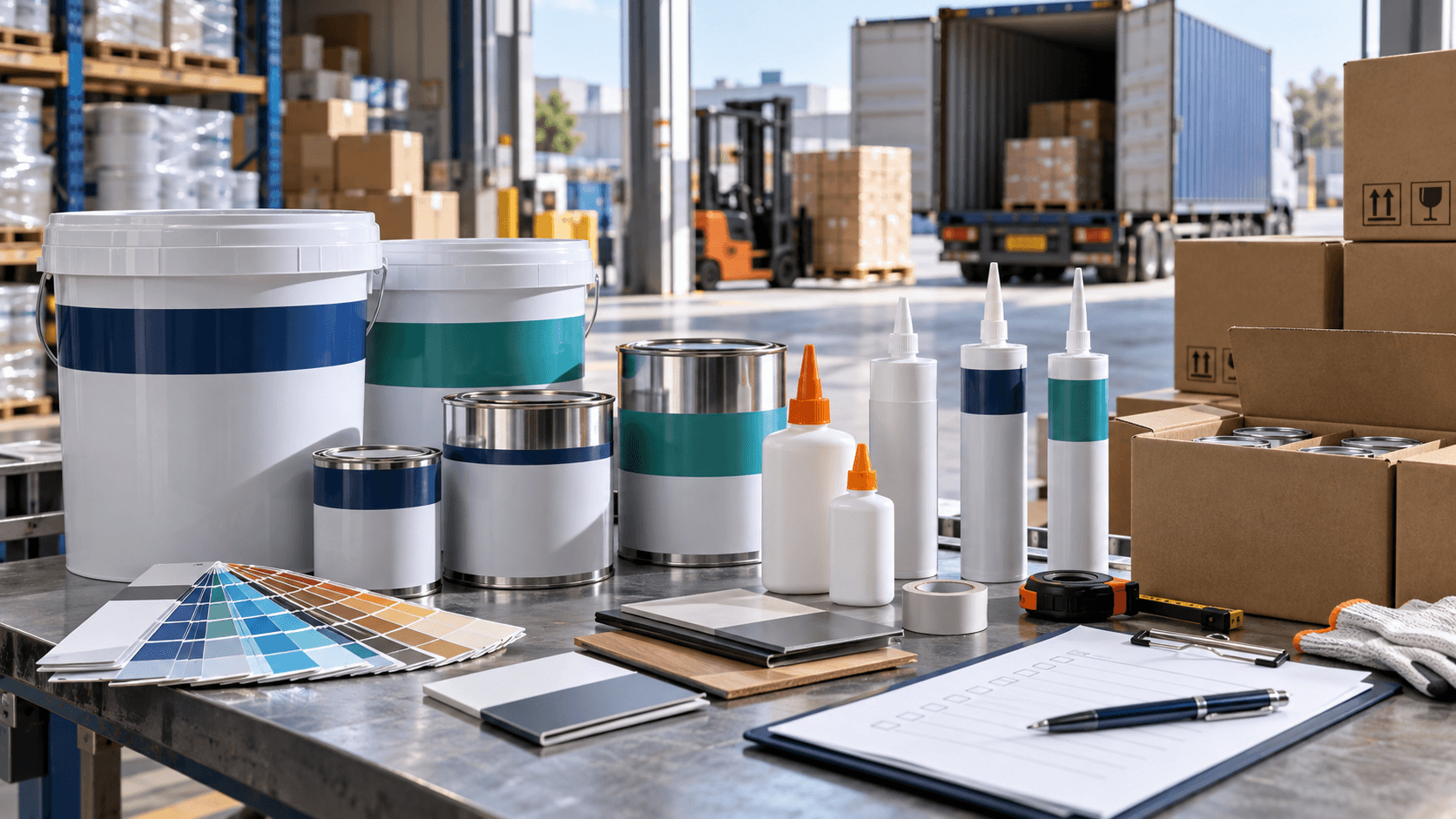
Successful private label sourcing from China depends on a controlled specification and approval process. Importers should compare manufacturers using the same application brief, technical evidence, samples, packaging requirements, quality plan and shipment documents—not a mixed collection of catalogue prices.
1. Turn the enquiry into a buyer brief
A useful brief states the product type, application, substrates, environment, target performance, destination market, package size, label language, estimated quantity and target delivery window. Include a reference specification or test standard when one exists.
Separate essential requirements from preferences. For example, a destination-market restriction or minimum adhesion result may be mandatory, while a particular pail colour may be negotiable. This helps suppliers propose alternatives without silently changing critical performance.
- Application and substrate
- Required performance and test method
- Destination country and compliance needs
- Pack size, artwork and language
- Quantity by SKU and delivery target
2. Shortlist capability by product family
A long catalogue does not prove manufacturing depth in every category. Ask which products are formulated and filled on site, which packaging lines are available and which items are sourced from partners. The answer matters for change control, lead time and accountability.
Match the factory to the risk. Silicone sealants require control of cure behaviour and package integrity; water-based paints need colour, viscosity and film-performance controls; two-component or industrial coatings add mixing-ratio, component and hazardous-goods considerations.
3. Compare evidence, not presentation
Request the current technical data sheet, safety data sheet, product specification and representative sample for the exact grade quoted. Where a claim depends on a standard, ask for the test method, report scope, laboratory and date. Check that the product name and code match across the quotation, documents and sample.
Quality-system certificates can support due diligence, but they do not prove that a specific product meets your requirement. Product-specific evidence, batch records and a realistic application trial remain important.
4. Use a clear private label development sequence
A practical sequence is: confirm the product brief, receive an unbranded technical sample, approve the formula, develop artwork, approve a packaging mock-up, confirm the purchase specification, then produce and inspect the order. Changing formula and packaging at the same time makes problems difficult to trace.
Artwork approval should cover brand files, colour references, product claims, directions, warnings, importer details, batch coding and barcode. Responsibility for legal review in the destination market should be explicit.
5. Compare MOQ, price and landed cost correctly
Ask for MOQ per formulation, colour and package—not only a total order quantity. Printed cartridges, custom pails, metal cans, labels and cartons can each have different component minimums. Combining products in one container does not automatically reduce every SKU minimum.
Create a landed-cost comparison that uses the same Incoterm, net content, packing density, pallet method, documentation, inspection and freight assumptions. Also consider leakage, denting, relabelling and slow-moving custom colours as commercial risks.
6. Approve samples under real use conditions
Test the sample on representative substrates with the actual application method. Record temperature, humidity, preparation, film or bead size and cure or drying time. For colour products, use a controlled physical standard; for bonding or sealing products, observe the full cure and service conditions.
Keep a signed reference sample and record its batch or sample code. When appropriate, use an independent laboratory or local customer trial before the full production order. A courier sample without traceability is difficult to use as a production standard.
7. Agree the production quality plan
The purchase specification should list raw-material or in-process controls where relevant, finished-batch acceptance tests, net-content and packaging checks, sampling frequency, retained samples and required certificates. Decide whether inspection will be performed by the buyer, a third party or the supplier under an agreed report format.
For the first order, a pre-production check and final random inspection can reveal artwork, quantity and packing problems before shipment. Technical tests that require full cure must be scheduled early enough to avoid forcing a shipping decision before results are available.
8. Confirm export and destination documents
Document requirements vary by chemistry, transport mode and destination. Confirm the commercial invoice, packing list, bill of lading instructions, certificate of origin if required, SDS format, dangerous-goods classification and any product or customs documents with qualified logistics and compliance advisers.
Names, weights, package counts and product codes should be consistent across documents and labels. Resolve discrepancies before loading, because small differences can create customs, insurance or customer-receipt delays.
9. Score suppliers with the same matrix
Use a weighted scorecard covering technical fit, evidence quality, sample result, packaging capability, quality control, communication, lead time, commercial terms and export readiness. Record open points and the person responsible for closing them.
Price should be one scored factor, not the first filter. A supplier that asks precise questions, documents limitations and controls revisions can be lower risk than one that immediately agrees to every claim.
- Technical fit and verified sample
- Document consistency
- Batch control and traceability
- Private label execution
- Export packing and documentation
- Communication and change control
- Comparable landed cost
10. A practical first-order sequence
Week one can focus on the buyer brief and document review. The next stage covers samples and packaging feasibility, followed by application testing and commercial comparison. Artwork and the purchase specification should be frozen only after the product is approved.
Before shipment, close the inspection report, batch documents, loading plan and final document draft. After arrival, record receiving condition and customer feedback so the next production order improves rather than simply repeats.
Frequently asked questions
How can importers compare paint and coating manufacturers?
Give each supplier the same buyer brief and score technical fit, product evidence, sample performance, batch controls, packaging capability, export documents, lead time and landed cost. Avoid comparing quotations built on different grades or fill sizes.
What should buyers ask an adhesive manufacturer before importing?
Ask about application and substrate limits, TDS and SDS documents, test methods, sample traceability, batch controls, retained samples, package options, MOQ by SKU, lead time, change control and shipment documents.
What information is needed for a private label paint order?
Provide the use and substrate, target performance, colour and sheen, destination market, pack sizes, artwork languages, quantity per SKU, testing needs, pallet preference and delivery destination.
Should a buyer use an independent inspection?
It depends on product risk, order value and supplier history. First orders and custom packaging often benefit from an independent or buyer-approved inspection plan, while laboratory testing should be arranged separately when specialist methods are required.