
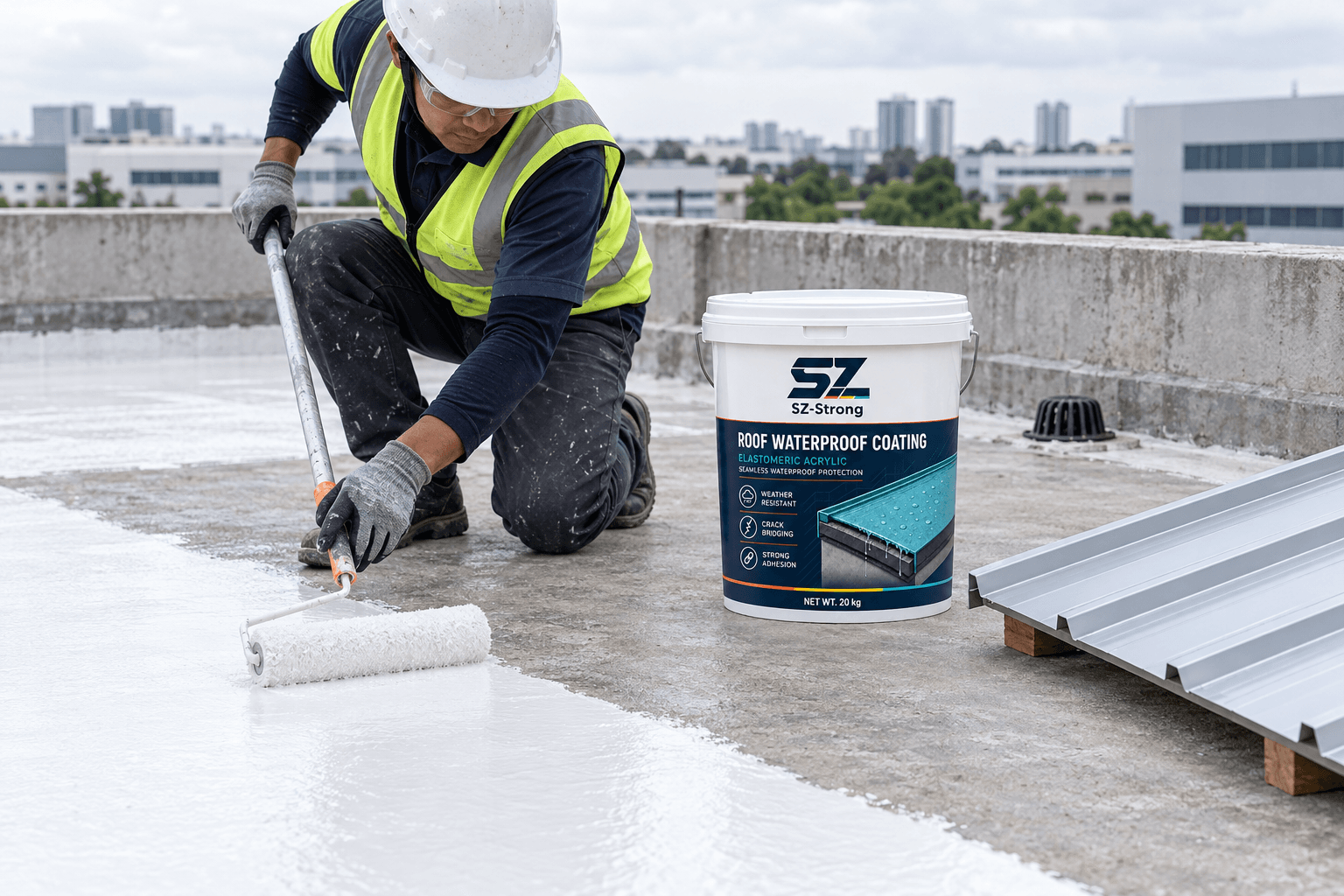
Choosing a roof waterproof coating manufacturer starts with the roof, not the product label. Concrete and metal roofs move, drain and weather differently. Importers and project buyers should define the substrate, defects, slope, standing-water risk, climate and required service conditions before comparing liquid roof waterproofing formulations, test evidence, application instructions and OEM supply terms.
1. Write a roof condition brief before requesting a price
A roof-waterproofing enquiry should state whether the project is new construction or repair, the roof area, slope, drainage layout, substrate, existing coating and visible defects. Include the destination climate, expected rainfall, ultraviolet exposure, service temperature and whether water can remain after rain. Photos and close-ups of cracks, seams, drains and penetrations help the supplier understand the system risk.
Separate waterproofing from other goals. Reflectivity, heat reduction, decorative colour, traffic resistance and corrosion protection may be useful, but each requires specific evidence and may change the system. Do not assume that a white coating is automatically a complete waterproofing membrane or that one liquid product can correct poor drainage.
- Concrete, metal or existing membrane
- New roof or repair project
- Slope, drains and standing-water risk
- Cracks, seams, fasteners and penetrations
- Climate, exposure and maintenance access
2. Concrete roofs need moisture and crack assessment
Concrete can be porous, alkaline, dusty or damp, and new concrete needs sufficient curing and drying before many coating systems are applied. Existing roofs may contain moving cracks, failed repairs, laitance, contamination or trapped moisture. These conditions can cause blistering, loss of adhesion or renewed leakage even when the topcoat itself is sound.
Ask the roof waterproof coating manufacturer to define surface preparation, acceptable moisture condition, primer requirements and how static cracks, moving joints, upstands, drains and penetrations should be detailed. Reinforcement fabric or a separate joint treatment may be required at local details. The final recommendation should identify the entire build, not just the finish coat.
3. Metal roofs require movement and corrosion planning
Metal roofs expand and contract with temperature change. Their weak points commonly include overlaps, fasteners, flashings, penetrations and areas where corrosion or an old coating has reduced adhesion. Identify whether the roof is galvanized steel, aluminium or another metal and describe any factory coating already present.
The preparation plan may include cleaning, removal of loose rust or coating, localized repair and a compatible primer. Seams and fasteners may need a flexible detail treatment before the field coating. Request compatibility confirmation for the actual metal and existing finish; a coating that adheres to bare steel may not perform the same way on an aged factory coating.
4. Compare complete liquid waterproofing systems
Liquid-applied roof waterproofing works as a system of preparation, primer where required, local detailing, reinforcement where specified and one or more coating layers. Coverage and wet-film thickness determine the resulting dry-film build. A low price per kilogram is not meaningful if the proposed system requires a different consumption rate or number of coats.
Ask every supplier to quote against the same roof area and system build. The quotation should state theoretical coverage, recommended number of coats, application method, recoat window, curing conditions and total material by component. Add a practical allowance for substrate roughness, detailing and site waste rather than relying only on a laboratory coverage figure.
5. Match test evidence to the intended use
Useful technical information can include tensile strength, elongation, adhesion, water impermeability, low-temperature flexibility, heat or ultraviolet ageing and crack-bridging behaviour, depending on the system and market. The test method, specimen preparation and acceptance criterion are essential because a number without its method is difficult to compare.
Request the technical data sheet and safety data sheet for the exact quoted product. If the destination or project specifies a national or international standard, give the requirement to the supplier and ask for applicable reports. Reflectance, solar performance, fire performance or potable-water claims should only be used when relevant evidence covers the proposed product and use.
- Exact product code on quotation, sample and documents
- Test method and reported conditions
- Adhesion to the intended substrate
- Weathering and flexibility relevant to the climate
- Batch release or quality-control records
6. Control application conditions and film build
Roof coating performance depends heavily on installation. The surface must be prepared and sufficiently dry, weather should remain within the stated limits and each coat needs the correct application rate and drying time. Rain, dew, very high surface temperature or early recoating can interrupt film formation.
For project supply, agree how the contractor will check consumption or wet-film thickness and record batch numbers, weather and completed areas. A small site trial can confirm preparation, primer, appearance and drying before the main roof is coated. Written application guidance should be available in the language needed by the contractor.
7. Do not use coating to hide drainage defects
A waterproof coating cannot correct inadequate falls, blocked drains, unstable substrates or moving structural joints. Persistent standing water can place extra stress on some acrylic and other liquid-applied systems. The roof design and drainage should be reviewed separately, and any limitation regarding ponding water must be clear before product selection.
Details usually fail before open roof areas. Include parapet junctions, outlets, gutters, equipment bases, pipe penetrations and changes of material in the inspection and method statement. Ask who is responsible for deciding the detail treatment and how completed work will be inspected before handover.
8. Define OEM packaging as part of the specification
For an acrylic roof coating OEM order, confirm pail size and material, net content, lid and tamper features, handle, label or in-mould decoration, batch code, units per pallet and loading arrangement. Label directions must match the approved system, consumption, drying limits and safety information rather than making unsupported universal claims.
Custom pails, labels and colours can have different minimum quantities. Ask for MOQ by SKU and separate the product batch minimum from the printed-package minimum. Approve a physical pack or production mock-up and check barcode, small text, lid fit, leakage resistance and pallet stability before the first shipment.
9. Evaluate the supplier beyond the sample
A good sample is only one part of supplier evaluation. Ask how raw materials are approved, which in-process and finished-batch tests are recorded, how batches are traced and whether retained samples are kept. Confirm change control so that future formulation, colour or packaging revisions cannot be made without agreed approval.
Compare roof waterproofing suppliers using the same technical and commercial scorecard: system fit, evidence quality, trial result, quality controls, packaging capability, lead time, export documents and landed cost. The most useful supplier will explain limitations and request project information instead of recommending one product for every roof.
- Written system proposal for the actual roof
- Traceable sample and site trial
- Batch tests and retained-sample policy
- OEM artwork and packaging approval
- MOQ, lead time and pallet plan
- Export and destination documents
Frequently asked questions
What waterproof coating is suitable for a concrete roof?
The choice depends on concrete condition, moisture, cracks, slope, drainage, climate and required service conditions. A compatible liquid-applied system may include preparation, primer, crack and detail treatment, reinforcement where specified and the required coating build. A site assessment and trial are recommended.
Can the same roof waterproof coating be used on metal and concrete?
Some coating families may be proposed for both, but preparation, primer, detailing and movement requirements are different. Compatibility and adhesion must be confirmed on the actual concrete or metal finish, and the supplier should provide a substrate-specific system.
How do buyers compare roof coating coverage?
Compare the complete system at the required dry-film build. Ask for theoretical coverage, solids or dry-film basis where applicable, number of coats, substrate allowance and total material for the same roof area. Price per kilogram alone does not show installed system cost.
What should be tested before a bulk roof coating order?
Review the exact TDS and SDS, relevant performance reports, substrate adhesion, application and drying in representative conditions, final appearance and package integrity. Project or destination standards may require additional independent testing.
Can roof waterproof coating be private labelled?
Private label supply can be discussed for suitable formulations and quantities. Confirm the approved product, pail size, net content, artwork, directions, claims, batch coding, carton or pallet plan, MOQ and destination-market requirements before production.